Thủ Phủ Hacker Mũ Trắng Buôn Ma Thuột

Chương trình Đào tạo Hacker Mũ Trắng Việt Nam tại Thành phố Buôn Ma Thuột kết hợp du lịch. Khi đi là newbie - Khi về là HACKER MŨ TRẮNG !

Hacking Và Penetration Test Với Metasploit

Chương trình huấn luyện sử dụng Metasploit Framework để Tấn Công Thử Nghiệm hay Hacking của Security365.

Tài Liệu Computer Forensic Của C50

Tài liệu học tập về Truy Tìm Chứng Cứ Số (CHFI) do Security365 biên soạn phục vụ cho công tác đào tạo tại C50.

Sinh Viên Với Hacking Và Bảo Mật Thông Tin

Cuộc thi sinh viên cới Hacking. Với các thử thách tấn công trang web dành cho sinh viên trên nền Hackademic Challenge.

Tấn Công Và Phòng Thủ Với BackTrack / Kali Linux

Khóa học tấn công và phòng thủ với bộ công cụ chuyên nghiệp của các Hacker là BackTrack và Kali LINUX dựa trên nội dung Offensive Security

Sayfalar

Showing posts with label Security Scanner. Show all posts

Nipper - Toolkit Web Scan for Android


La Primera herramienta de escáner de vulnerabilidades WEB, En entorno Android (Versión para iOS en desarrollo), este escáner de vulnerabilidad fue enfocado para CMS más usadas, (WordPress, Drupal, Joomla. Blogger ).

En su primera versión Nipper cuenta con 10 módulos distintos, para recopilar información acerca de un URL en específica.

Su interfaz ha sido pensada para que tan solo con unos “toques” en su interfaz extraerías gran parte de su información.

Módulos Disponibles:
  • IP Server
  • CMS Detect & Version
  • DNS Lookup
  • Nmap ports IP SERVER
  • Enumeration Users
  • Enumeration Plugins
  • Find Exploit Core CMS
  • Find Exploit DB
  • CloudFlare Resolver
Nipper NO requiere ROOT, tan solo requiere permiso a internet.
Compatible desde 2.3 a Android L.


Web Application Protection - Tool to detect and correct vulnerabilities in PHP web applications


WAP 2.0 is a source code static analysis and data mining tool to detect and correct input validation vulnerabilities in web applications written in PHP (version 4.0 or higher) and with a low rate of false positives. WAP detects and corrects the following vulnerabilities:
  • SQL Injection (SQLI)
  • Cross-site scripting (XSS)
  • Remote File Inclusion (RFI)
  • Local File Inclusion (LFI)
  • Directory Traversal or Path Traversal (DT/PT)
  • Source Code Disclosure (SCD)
  • OS Command Injection (OSCI)
  • PHP Code Injection

This tool semantically analyses the source code. More precisely, it does taint analysis (data-flow analysis) to detect the input validation vulnerabilities. The aim of the taint analysis is to track malicious inputs inserted by entry points ($_GET, $_POST arrays) and to verify if they reaches some sensitive sink (PHP functions that can be exploited by malicious input). After the detection, the tool uses data mining to confirm if the vulnerabilities are real or false positives. At the end, the real vulnerabilities are corrected with the insertion of the fixes (small pieces of code) in the source code. WAP is written in Java language and is constituted by three modules:
  • Code Analyzer: composed by tree generator and taint analyser. The tool has integrated a lexer and a parser generated by ANTLR, and based in a grammar and a tree grammar written to PHP language. The tree generator uses the lexer and the parser to build the AST (Abstract Sintatic Tree) to each PHP file. The taint analyzer performs the taint analysis navigating through the AST to detect potentials vulnerabilities.

  • False Positives Predictor: composed by a supervised trained data set with instances classified as being vulnerabilities and false positives and by the Logistic Regression machine learning algorithm. For each potential vulnerability detected by code analyser, this module collects the presence of the attributes that define a false positive. Then, the Logistic Regression algorithm receives them and classifies the instance as being a false positive or not (real vulnerability).

  • Code Corrector: Each real vulnerability is removed by correction of its source code. This module for the type of vulnerability selects the fix that removes the vulnerability and signalizes the places in the source code where the fix will be inserted. Then, the code is corrected with the insertion of the fixes and new files are created.     

Netsparker v3.5.5 - Web Application Security Scanner


Netsparker Web Application Security Scanner can find and report web application vulnerabilities such as SQL Injection and Cross-site Scripting (XSS) and security issues on all web applications and websites regardless of the platform and the technology they are built on. 


Netsparker is very easy to use and its unique detection and safe exploitation techniques allow it to be dead accurate in reporting hence it is the first and only False Positive Free web vulnerability scanner, therefore users can focus on remediating reported vulnerabilities and security issues without wasting time on learning how to use the web vulnerability scanner or verify its findings.

NEW FEATURES 
* New option available to specify the type of parameter when configuring URL rewrite rules, e.g. numeric, date, alphanumeric

IMPROVEMENTS 
* Improved the performance of the DOM Parser
* Improved the performance of the DOM cross-site scripting scanner
* Optimized DOM XSS Scanner to avoid scanning pages with same source code
* Changed the default HTTP User agent string of built-in policies to Chrome web browser User agent string
* Improved selected element simulation for select HTML elements
* Added new patterns for Open Redirect engine

FIXES 
* Fixed a bug in WSDL parser which prevents web service detection if XML comments are present before the definitions tag
* Fixed a bug in WSDL parser which prevents web service detection if an external schema request gets a 404 not found response
* Fixed a bug that occurs when custom URL rewrite rules do not match the URL with injected attack pattern and request is not performed
* Fixed a configure form authentication wizard problem where the web browser does not load the page if the target site uses client certificates
* Fixed a crash in configure form authentication wizard that occurs when HTML source code contains an object element with data: URL scheme is requested
* Fixed a bug in DOM Parser where events are not simulated for elements inside frames
* Fixed a cookie parsing bug where a malformed cookie was causing an empty HTTP response


Netsparker v3.5 - Web Application Security Scanner


Netsparker Web Application Security Scanner can find and report web application vulnerabilities such as SQL Injection and Cross-site Scripting (XSS) and security issues on all web applications and websites regardless of the platform and the technology they are built on. 


Netsparker is very easy to use and its unique detection and safe exploitation techniques allow it to be dead accurate in reporting hence it is the first and only False Positive Free web vulnerability scanner, therefore users can focus on remediating reported vulnerabilities and security issues without wasting time on learning how to use the web vulnerability scanner or verify its findings.

Changelog - 3.5.3

NEW FEATURES

* DOM based cross-site scripting vulnerability scanning
* Chrome based web browser engine for DOM parsing
* URL rewrite rules configuration wizard (to scan parameters in URLs)
* "Ignore Vulnerability from Scan" option to exclude vulnerabilities from reports

NEW SECURITY TESTS

* Nginx web server Out-of-date version check
* Perl possible source code disclosure
* Python possible source code disclosure
* Ruby possible source code disclosure
* Java possible source code disclosure
* Nginx Web Server identification
* Apache Web Server identification
* Java stack trace disclosure

IMPROVEMENTS

* Improved the correctness and coverage of Remote Code Execution via Local File Inclusion vulnerabilities
* Improved cross-site scripting vulnerability confirmation patterns
* Added support for viewing JSON arrays in document roots in request/response viewers
* Added support for Microsoft Office ACCDB database file detection
* Improved DOM parser to exclude non-HTML files
* Improved PHP Source Code Disclosure vulnerability detection
* Improved Nginx Version Disclosure vulnerability template
* Improved IIS 8 Default Page detection
* Improved Email List knowledgebase report to include generic email addresses
* Improved Configure Form Authentication wizard by replacing embedded record browser with a Chrome based browser
* Improved the form authentication configuration wizard to handle cases where Basic/NTLM/Digest is used in conjunction with Form Authentication
* Added a cross-site scripting attack pattern which constructs a valid XHTML in order to trigger the XSS
* Added double encoded attack groups in order to reduce local file inclusion vulnerability confirmation requests
* Added status bar label which displays current VDB version and VDB version update notifications
* Added login activity indicator to Scan Summary Dashboard
* Added a new knowledgebase out-of-scope reason for links which exceed maximum depth
* Updated external references in cross-site scripting vulnerability templates
* Improved DOM parser by providing current cookies and referer to DOM/JavaScript context
* Added several new DOM events to simulate including keyboard events
* Improved the parsing of "Anti-CSRF token field names" setting by trimming each individual token name pattern
* Added support for simulating DOM events inside HTML frames/iframes
* Consolidated XSS exploitation function name (netsparker()) throughout all the areas reported
* Removed redundant semicolon followed by waitfor delay statements from time based SQLi attack patterns to bypass more blacklistings
* Changed default user-agent string to mimic a Chrome based browser
* Improved LFI extraction file list to extract files from target system according to detected OS
* Removed outdated PCI 1.2 classifications

FIXES

* Fixed indentation problem of bullets in knowledgebase reports
* Fixed path disclosure reports in MooTools JavaScript file
* Fixed KeyNotFoundException occurs when a node from Sitemap tree is clicked
* Fixed NullReferenceException thrown from Boolean SQL Injection Engine
* Fixed an issue in WebDav Engine where an extra parameter is added when requesting with Options method
* Fixed a bug where LFI exploitation does not work for double encoded paths
* Fixed a bug in Export file dialog where .nss extension isn't appended if file name ends with a known file extension
* Fixed a bug in Configure Form Authentication wizard where the number of scripts loaded shows incorrectly
* Fixed a bug which occurs while retesting with CSRF engine
* Fixed a bug where retest does not work after loading a saved scan session
* Fixed a bug where Netsparker reports out of date PHP even though PHP is up to date
* Fixed a UI hang where Netsparker tries to display a binary response in Browser View tab
* Fixed an ArgumentNullException thrown when clicking Heartbleed vulnerability
* Fixed a bug where Netsparker makes requests to DTD URIs in XML documents
* Fixed a bug in Scan Policy settings dialog where list of user agents are duplicated
* Fixed a typo in ViewState MAC Not Enabled vulnerability template
* Fixed a bug in auto updater where the updater doesn't honour the AutoPilot and Silent command line switches
* Fixed XSS exploit generation code to handle cases where input name is "submit"
* Fixed a bug that prevents Netsparker.exe process from closing if you try to close Netsparker immediately after starting a new scan
* Fixed a UI hang happens when the highlighted text is huge in response source code
* Fixed issues with decoded HTML attribute values in text parser
* Fixed session cookie path issues according to how they are implemented in modern browsers
* Fixed scan stuck at re-crawling issue for imported scan sessions
* Fixed highlighting issues for possible XSS vulnerabilities
* Fixed a crash due to empty/missing URL value for form authentication macro requests
* Fixed a NullReferenceException in Open Redirect Engine which occurs if redirect response is missing Location header
* Fixed an error in authentication macro sequence player happens when the request URI is wrong or missing


w3af - Open Source Web Application Security Scanner

w3af, is a Web Application Attack and Audit Framework. The w3af core and it’s plugins are fully written in python, it identifies more than 200 vulnerabilities and reduce your site’s overall risk exposure. Identify vulnerabilities like SQL Injection, Cross-Site Scripting, Guessable credentials, Unhandled application errors and PHP misconfigurations.

Changelog v1.6

  • Improved performance: your scans will run faster
  • Improved quality: 1300+ unittests are run after each change to make sure we don’t add any regressions
  • Now you’ll be able to easily integrate w3af into other projects with a simple import w3af
  • Better documentation

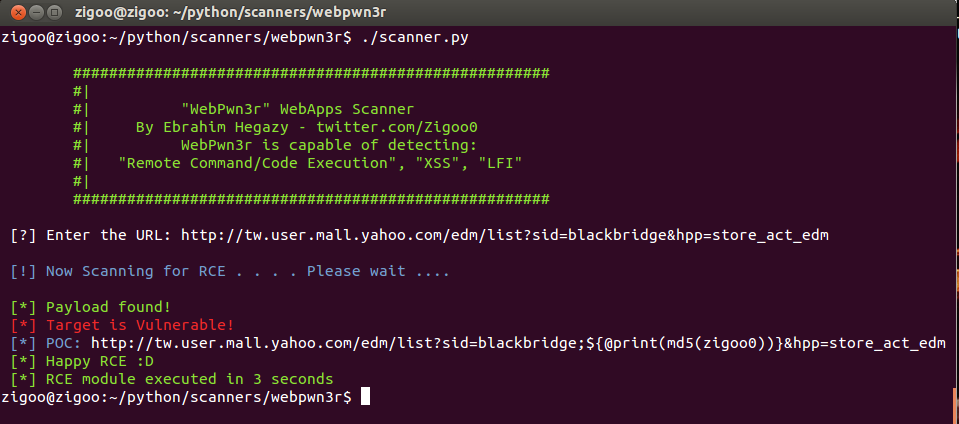
WebPwn3r - Web Applications Security Scanner


WebPwn3r is a Web Applications Security Scanner coded in Python to help Security Researchers to scan Multiple links in the same time against Remote Code/Command Execution & XSS Vulnerabilities.

You can extract the URL’s from Burp Suite and save it in list.txt then pass it to WebPwn3r.

You can also use your own crowler to gather URL’s for a certain domain or a random domains, and save it in list.txt then pass it to WebPwn3r.

WebPwn3r got below Features:

1- Scan a URL or List of URL’s
2- Detect and Exploit Remote Code  Injection Vulnerabilities.
3- ~ ~ ~ Remote Command  Execution Vulnerabilities.
4- ~ ~ ~ Typical XSS Vulnerabilities.
5- Detect WebKnight WAF.
6- Improved Payloads to bypass Security Filters/WAF’s.
7- Finger-Print the backend Technologies.