


Showing posts with label PHP. Show all posts
Showing posts with label PHP. Show all posts

DAws - Advanced Web Shell (Windows/Linux)

There's multiple things that makes DAws better than every Web Shell out there:
- Bypasses Disablers; DAws isn't just about using a particular function to get the job done, it uses up to 6 functions if needed, for example, if shell_exec was disabled it would automatically use exec or passthru or system or popen or proc_open instead, same for Downloading a File from a Link, if Curl was disabled then file_get_content is used instead and this Feature is widely used in every section and fucntion of the shell.
- Automatic Encoding; DAws randomly and automatically encodes most of your GET and POST data using XOR(Randomized key for every session) + Base64(We created our own Base64 encoding functions instead of using the PHP ones to bypass Disablers) which will allow your shell to Bypass pretty much every WAF out there.
- Advanced File Manager; DAws's File Manager contains everything a File Manager needs and even more but the main Feature is that everything is dynamically printed; the permissions of every File and Folder are checked, now, the functions that can be used will be available based on these permissions, this will save time and make life much easier.
- Tools: DAws holds bunch of useful tools such as "bpscan" which can identify useable and unblocked ports on the server within few minutes which can later on allow you to go for a bind shell for example.
- Everything that can't be used at all will be simply removed so Users do not have to waste their time. We're for example mentioning the execution of c++ scripts when there's no c++ compilers on the server(DAws would have checked for multiple compilers in the first place) in this case, the function would be automatically removed and the User would know.
- Supports Windows and Linux.
- Openned Source.
Extra Info
- Eval Form:
- `include` is being used instead PHP `eval` to bypass Protection Systems.
- Download from Link - Methods:
- PHP Curl
- File_put_content
- Zip - Methods:
- Linux:
- Zip
- Windows:
- Vbs Script
- Shells and Tools:
- Extra:
- `nohup`, if installed, is automatically used for background processing.

Web Application Protection - Tool to detect and correct vulnerabilities in PHP web applications

WAP 2.0 is a source code static analysis and data mining tool to detect and correct input validation vulnerabilities in web applications written in PHP (version 4.0 or higher) and with a low rate of false positives. WAP detects and corrects the following vulnerabilities:
- SQL Injection (SQLI)
- Cross-site scripting (XSS)
- Remote File Inclusion (RFI)
- Local File Inclusion (LFI)
- Directory Traversal or Path Traversal (DT/PT)
- Source Code Disclosure (SCD)
- OS Command Injection (OSCI)
- PHP Code Injection
This tool semantically analyses the source code. More precisely, it does taint analysis (data-flow analysis) to detect the input validation vulnerabilities. The aim of the taint analysis is to track malicious inputs inserted by entry points ($_GET, $_POST arrays) and to verify if they reaches some sensitive sink (PHP functions that can be exploited by malicious input). After the detection, the tool uses data mining to confirm if the vulnerabilities are real or false positives. At the end, the real vulnerabilities are corrected with the insertion of the fixes (small pieces of code) in the source code. WAP is written in Java language and is constituted by three modules:
- Code Analyzer: composed by tree generator and taint analyser. The tool has integrated a lexer and a parser generated by ANTLR, and based in a grammar and a tree grammar written to PHP language. The tree generator uses the lexer and the parser to build the AST (Abstract Sintatic Tree) to each PHP file. The taint analyzer performs the taint analysis navigating through the AST to detect potentials vulnerabilities.
- False Positives Predictor: composed by a supervised trained data set with instances classified as being vulnerabilities and false positives and by the Logistic Regression machine learning algorithm. For each potential vulnerability detected by code analyser, this module collects the presence of the attributes that define a false positive. Then, the Logistic Regression algorithm receives them and classifies the instance as being a false positive or not (real vulnerability).
- Code Corrector: Each real vulnerability is removed by correction of its source code. This module for the type of vulnerability selects the fix that removes the vulnerability and signalizes the places in the source code where the fix will be inserted. Then, the code is corrected with the insertion of the fixes and new files are created.
PHP Secure Configuration Checker - Check current PHP configuration for potential security flaws

Among the most tedious tasks of PHP security testing is the check for insecure PHP configuration. As a successor of our PHP Security Poster, we have created a script to help system administrators as well as security professionals to assess the state of php.ini and related topics as quickly and as thoroughly as possible. For later reference, the script is called "PHP Secure Configuration Checker" , or pcc.
Inspiration and previous work
- phpinfo(): Just like phpinfo() the pcc is supposed to give a brief overview of security related configuration issues.
- phpsecinfo: This is an alternative project that appears to have been discontinued in 2007.
- SektionEins PHP Security Poster (2009-2011): Some text snippets and recommendations of our own work we put into the popular poster have been reused.
Ideas, Features and Software Design
- One single file for easy distribution: In respect to an update process and access restrictions, a single file can be handled easier than a whole web application monster.
- Simple tests for each security related ini entry: Testing php.ini on a live system is the main aspect of this project. Each entry is supposed to be checked or otherwise actively ignored.
- A few other tests: pcc is not restricted to php.ini checks. Other ideas can be implemented as well.
- Compatibility: PHP 5.4 is supposed to work. Older PHP versions are not supposed to be used in the wild anyway.
- NO complicated/overengineered code, e.g. no classes/interfaces, test-frameworks, libraries, ...: In most cases, a recommendation is based on a simple boolean decision, e.g. is it 1 or is it 0. The corresponding code is supposed to reflect this simplicity. Also, simple code leads to fewer programming errors.
- Novice factor: The result is supposed to help secure the PHP environment. There is no need to obfuscate, encrypt or hide the code. Even unexperienced developers or system administrators may take a glance at the code - free of charge.
- NO (or very few) dependencies: pcc is supposed to run in the most simplistic (yet still realistically sane) PHP environment. Writing files and loading bloated library code should be avoided.
- Safeguards: In order to prevent information disclosure, IP restrictions are implemented, as well as a lock-out mechanism based on the script's modification time.
- Suhosin: pcc checks the correct configuration of the Suhosin extension.
FuckShitUp - Multi Vulnerabilities Scanner written in PHP

Basically, FSU is bunch of tools written in PHP-CLI. Using build-in functions, you are able to grab url's using search engines - and so, dork for interesting files and full path disclosures. Using list of url's, scanner will look for Cross Site Scripting, Remote File Inclusion, SQL Injection and Local File Inclusion vulnerabilities. It is able to perform mass bruteforce attacks for specific range of hosts, or bruteforce ssh with specific username taken from FPD. Whenever something interesting will be found, like vulnerability or broken auth credentials, data will be saved in .txt files - just like url's, and any other files. FSU is based on PHP and text files, it's still under construction so i am aware of any potential bugs. Principle of operation is simple.
More url's -> more vuln's. For educational purposes only.
Intro
- Data grabbing:
- URL's (geturl/massurl) -> (scan)
- Configs, Databases, SQLi's (dork)
- Full Path Disclosures / Users (fpds) -> (brutefpds)
- Top websites info (top)
- Massive scanning
- XSS, SQLi, LFI, RFI (scan)
- FTP, SSH, DB's, IMAP (multibruter)
- Accurate SSH bruteforce (brutefpds)
Plan
- Web Apps
- Grab url's via 'geturl' or 'massurl' (massurl requires list of tags as file)
- Scan url's parameters for vulns with 'scan'
- Servers
- Pick target, get ip range
- Scan for services on each IP and bruteforce with 'multibruter'
- Grab full path disclosures, and so linux usernames
- Perform SSH bruteforce for specific user with 'brutefpds'
- Info grabbing
- Use 'dork' for automatic dorking
- Use 'fpds' for full path disclosure grabbing
- Use 'search' for searching someone in ur databases
- Use 'top' for scanning all top websites of specific nation
- Others
- 'Stat' shows actual statistics and informations
- 'Show' display specific file
- 'Clear' and 'filter' - remove duplicates, remove blacklisted url's
Others
MultiBrtuer requirements (php5):
- php5-mysql - for mysql connections
- php5-pgsql - for postgresql connections
- libssh2-php - for ssh connections
- php5-sybase - for mssql connections
- php5-imap - for imap connections
TODO:
- Fix problems with grabbing large amount of url's
- More search engines
- SQL Injector
- RFI shell uploader
- FSU is not secure as it should be
Hostscan - PHP tool for scanning specific range of hosts

Hostscan is a php tool which allows you to scan specific range of hosts, mostly for information gathering and testing for weak passwords. I guess it's a pentest tool, i'd created it to automate some tests that i often do. Since it's PHP, it works quite slowly compared to client-side soft.
How it works?
- You need to provide range of ip's (e.g. 127.0.0.1 - 127.0.0.10); program will perform operations on each address separately, basing on selected options, then it will print out the response.
- By default, program will only check open ports, print http response headers, test for HTTP methods and check FTP for anonymous login.
- If 'SSH/IMAP/DB's' are checked, program will try to bruteforce SSH,IMAP,MySQL,PostgreSQL & MsSQL using array of passwords and users defined on the beggining of script. Notice, that it will try to login as user with grand permissions (e.g. root, postgres), although you're able to edit it.
- If 'FTP User' is set, program will also try to bruteforce FTP with specific user using mentioned passwords array. By default it's not, and it will only test for anonymous login.
- If 'Deep Scan' is set, program will perform all aforementioned operations. Further, it will use nmap with specific parameters you're able to edit, also, the traceroute scan will be performed and displayed - just like nmap. Deep Scan also gather some useful informations about a website (if it's running), such as interesting files/folders and www title.
- ?url=website.com for quick IP address of specific website....so - what it does it do? Nmap, traceroute, port scan, ftp anonymous login, ftp/ssh/imap/mysql/pgsql/mssql bruteforce, http (website) info gathering,Crawler accepts as a parameter array of files and folders that you can manually edit, just like others options.
[Weevely v1.1] Stealth tiny PHP web shell

Weevely is a stealth PHP web shell that provides a telnet-like console. It is an essential tool for web application post exploitation, and can be used as stealth backdoor or as a web shell to manage legit web accounts, even free hosted ones.
Weevely is currently included in Backtrack and Backbox and all the major Linux distributions oriented for penetration testing.
- More than 30 modules to automate administration and post exploitation tasks
- Execute commands and browse remote filesystem, even with PHP security restriction
- Audit common server misconfigurations
- Run SQL console pivoting on target machine
- Proxy your HTTP traffic through target
- Mount target filesystem to local mount point
- Simple file transfer from and to target
- Spawn reverse and direct TCP shells
- Bruteforce SQL accounts through target system
- Run port scans from target machine
- And so on..
- Backdoor communications are hidden in HTTP Cookies
- Communications are obfuscated to bypass NIDS signature detection
- Backdoor polymorphic PHP code is obfuscated to avoid HIDS AV detection
[aidSQL] PHP Application For SQL Injection Detection & Exploitation
 aidSQL a PHP application provided for detecting security holes in your website/s. It’s a modular application, meaning that you can develop your very own plugins for SQL injection detection & exploitation.
The tool provides pen-testing capabilities for MS-SQL 2000, MySQL 5 and the author promises to add Oracle 10g support – but that doesn’t seem to be happening.
You can view a demo of the app here:
The output from Wavsep for aidSQL can also be seen here:
aidSQL vs Wavsep
Read more here.
[RIPS] A static source code analyser for vulnerabilities in PHP scripts

RIPS is a tool written in PHP to find vulnerabilities in PHP applications using static code analysis. By tokenizing and parsing all source code files RIPS is able to transform PHP source code into a program model and to detect sensitive sinks (potentially vulnerable functions) that can be tainted by userinput (influenced by a malicious user) during the program flow. Besides the structured output of found vulnerabilities RIPS also offers an integrated code audit framework for further manual analysis.
vulnerabilities
- Code Execution
- Command Execution
- Cross-Site Scripting
- Header Injection
- File Disclosure
- File Inclusion
- File Manipulation
- LDAP Injection
- SQL Injection
- Unserialize with POP
- XPath Injection
- ... other
code audit interface
- scan and vulnerability statistics
- grouped vulnerable code lines (bottom up or top down)
- vulnerability description with example code, PoC, patch
- exploit creator
- file list and graph (connected by includes)
- function list and graph (connected by calls)
- userinput list (application parameters)
- source code viewer with highlighting
- active jumping between function calls
- search through code by regular expression
- 8 syntax highlighting designs
- ... much more
static code analysis
- fast
- tokenizing with PHP tokenizer extension
- taint analysis for 232 sensitive sinks
- inter- and intraprocedural analysis
- handles very PHP-specific behaviour
- handles user-defined securing
- reconstruct file inclusions
- detect blind/non-blind exploitation
- detect backdoors
- 5 verbosity levels
- over 100 testcases
- ... much more
[Weevely] PHP Stealth Tiny Web Shell
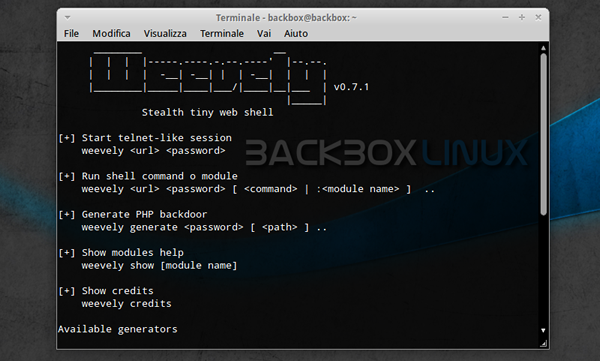
Weevely is a stealth PHP web shell that provides a telnet-like console. It is an essential tool for web application post exploitation, and can be used as stealth backdoor or as a web shell to manage legit web accounts, even free hosted ones.
Weevely is currently included in Backtrack and Backbox and all the major Linux distributions oriented for penetration testing.
- More than 30 modules to automatize administration and post exploitation tasks:
- Execute commands and browse remote filesystem, even with PHP security restriction
- Audit common server misconfigurations
- Run SQL console pivoting on target machine
- Proxy your HTTP traffic through target
- Mount target filesystem to local mount point
- Simple file transfer from and to target
- Spawn reverse and direct TCP shells
- Bruteforce SQL accounts through target system
- Run port scans from target machine
- And so on..
- Backdoor communications are hidden in HTTP Cookies
- Communications are obfuscated to bypass NIDS signature detection
- Backdoor polymorphic PHP code is obfuscated to avoid HIDS AV detection
You can download Weevely v1.0 here:
Or read more here.
Subscribe to:
Posts (Atom)


